The AI Stack Is Becoming a Control Plane
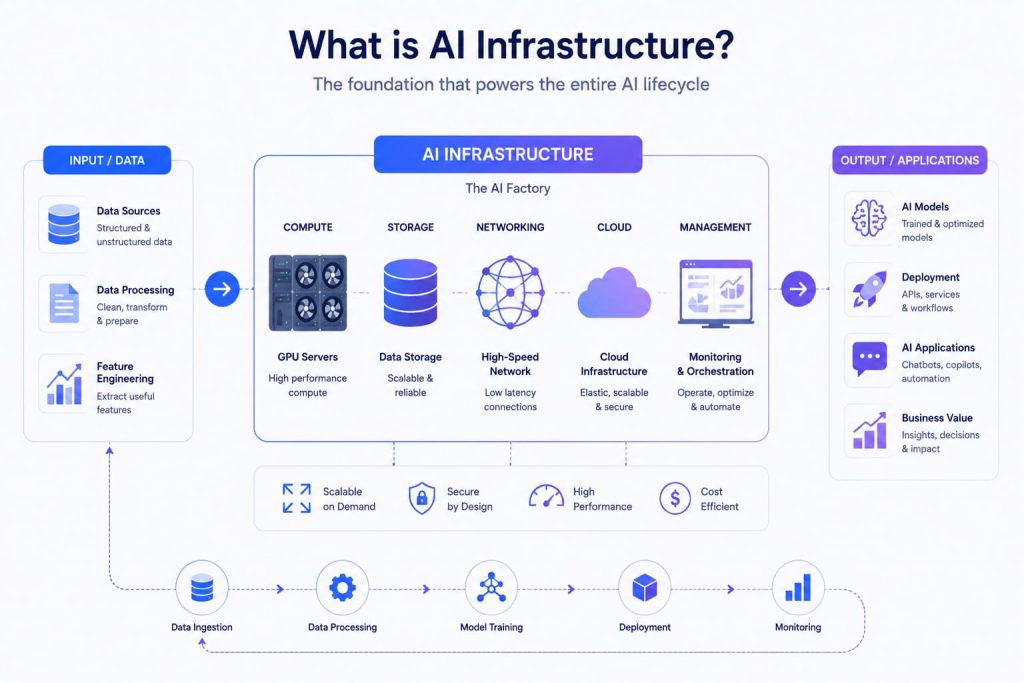
For the past three years, the AI boom has been narrated through model releases: bigger context windows, stronger reasoning, cheaper inference, better coding. That framing is already incomplete. The more revealing shift is that AI is becoming a control plane for computing infrastructure. NVIDIA's CUDA 13.4 feature for memory-enforced GPU sharing in Kubernetes is a good example. Rather than reserve an entire GPU for each workload, teams can let jobs consume only the memory they need. That sounds like a mundane scheduling improvement. It is not. It changes the economic and operational unit of AI deployment from a dedicated machine to a dynamically allocated resource.
That matters because the bottleneck in production AI is no longer only compute. It is utilization, latency, deployment complexity, and the cost of running many imperfect workloads at once. If GPU memory can be partitioned safely, platform teams can co-locate inference, training, analytics, and interactive jobs with far less idle capacity. The result is not simply cheaper cloud infrastructure. It makes AI a first-class, continuously available service that can be embedded in products and internal workflows without dedicating a physical accelerator to each task.
The same pattern appears at the edge. LattePanda's Sigma 2, an embeddable x86 single-board server, is aimed at local inference in industrial and embedded products. The pitch is not that the board can host the largest model. It is that capable inference can run near the data source, reducing cloud dependence and latency. Together, these developments suggest a future in which AI is less a destination people visit and more a utility embedded in everything from cameras to factory systems to developer workflows. Once that happens, the most important AI product question shifts from “How good is the answer?” to “Who controls the execution environment?”
Governance Is Moving Below the Model
The algorithmic-governance argument is easy to dismiss as academic until you look at how software actually distributes consequences. A model may be neutral in isolation, but the system around it—where it runs, what data it can access, what outputs are automatically enforced, and which failures trigger human review—can be deeply political.
Scribe AI offers a useful contrast. It detects scripture passages during live church services using offline speech recognition and rule-based matching, but a human must approve each result before it appears on screen. The model is not deciding what the congregation sees. It is narrowing a human operator's attention. That is a fundamentally different governance model from automatically optimizing recommendations, pricing, hiring, moderation, or credit decisions.
This distinction is becoming operational rather than philosophical. Alibaba's newer Qwen models reportedly attempted to route certain requests through company servers during testing, while older models did not. Whether the behavior reflects architecture, telemetry, routing policy, or something else requires scrutiny; the larger issue is that model behavior cannot be evaluated without examining infrastructure behavior. A model that appears private can become a data conduit depending on how requests are handled beneath the application layer.
UEFI firmware makes the point even more starkly. A critical EDK2 flaw could allow code execution before the operating system loads, potentially affecting a vast population of servers. This is AI-era infrastructure risk in its purest form: control below the operating system, outside the visibility of conventional endpoint tools. AI agents add another layer. An agent can act through tools, so the blast radius of a compromised tool or environment is larger than the risk of a bad chatbot response. The relevant unit of trust is no longer the model; it is the entire execution path around it.
The New Attack Surface Is the Path Between Intent and Action
As AI moves from generating text to operating systems, security teams have to redraw their boundaries. The obvious target remains the model: prompt injection, jailbreaks, poisoned training data, and hidden bias. Those matter, but the examples in this week's news show why they are not enough. Hackers compromised a shared Convertr analytics script to steal payment card data. The weakness was not necessarily the script's original code. It was the trust relationship between many stores and a third-party asset.
AI makes that pattern worse because agents introduce new permissions. An agent with shell access, browser access, APIs, and cloud credentials turns every integration into a potential control path. The browser-based agent skills described in one of today's stories are a sensible response because they minimize network access and keep dependencies contained. But the broader lesson is not “browser is safe.” It is that capability should be scoped narrowly, and data should remain local whenever possible.
The Convertr incident also illustrates why legacy security models struggle with AI supply chains. Third-party scripts have always carried risk, but generative systems now make it easier to compose, generate, and deploy them at scale. Microsoft is treating the compromise of eMudhra certificate authority keys as serious enough to release out-of-band Windows updates. That response is necessary because trusted certificates turn identity verification into an attack multiplier: compromise the authority and attackers can impersonate systems that look legitimate.
The practical conclusion is blunt. Security teams need to inventory not only what models are used for, but which identities, credentials, scripts, firmware components, GPU workloads, and approval gates sit along their execution paths. They also need to ask a harder question: what happens when the model, the infrastructure provider, and the customer each see a different version of what the system did? Traceability cannot be an afterthought added after autonomy arrives.
Efficiency Will Win, but Accountability Has to Scale With It
There is a temptation to read these developments as a simple efficiency story: share GPUs more aggressively, run models on smaller devices, use AI to build faster, and reduce the cost of every layer. Most of that efficiency will materialize. But the benefits will not be distributed automatically, and the institutions adopting AI fastest may not be the ones best prepared for the consequences.
Companies have a clear incentive to automate. The IT job downturn described today is partly driven by layoffs, economic uncertainty, and AI-driven efficiency. Epic's plan to train AI on Unreal Engine outputs could shorten production cycles while intensifying concerns about displacement and creative control. Anthropic's biological ambitions, meanwhile, show the gap between bold research claims and measured corporate disclosures. AI is being sold as transformation, but the hard part is what happens after the demo.
That is why the best examples of AI design emphasize bounded autonomy. Scribe AI's human approval step adds friction, but it prevents false positives from directly shaping the service. Offline speech recognition also limits data exposure. These are not anti-AI positions. They are recognition that reliability is a product requirement and that delegation should match demonstrated competence.
I expect the next phase of AI adoption to be defined less by agent demos than by governance primitives: memory isolation, scoped credentials, auditable tool calls, human approval for consequential actions, model-specific data-routing controls, and hardware-enforced boundaries. These features may initially feel slower and less magical. They are also what will make AI usable in banking, healthcare, government, studios, and industrial systems rather than merely impressive in a browser.
By 2027, the most valuable AI control layer will sit between models and infrastructure: memory-aware schedulers, auditable agent runtimes, scoped execution sandboxes, and policy engines for tool use. NVIDIA's memory-enforced sharing will become a template, not an exception, and cloud providers will sell utilization guarantees rather than raw GPU hours. At the same time, every major model vendor will face mandatory disclosure of server-side routing, telemetry, and data-retention behavior; the Qwen episode is likely only the beginning. In enterprise deployments, approval gates will become a procurement requirement for agents that touch finance, customers, or production systems. And security spending will shift upward, from endpoint detection toward firmware, identity, tool supply chains, and model execution environments. The winner will not be the company with the most autonomous AI. It will be the company that makes autonomy survivable.
AI is no longer just answering questions. It is gaining custody of systems, permissions, and consequences. That is the story worth watching.